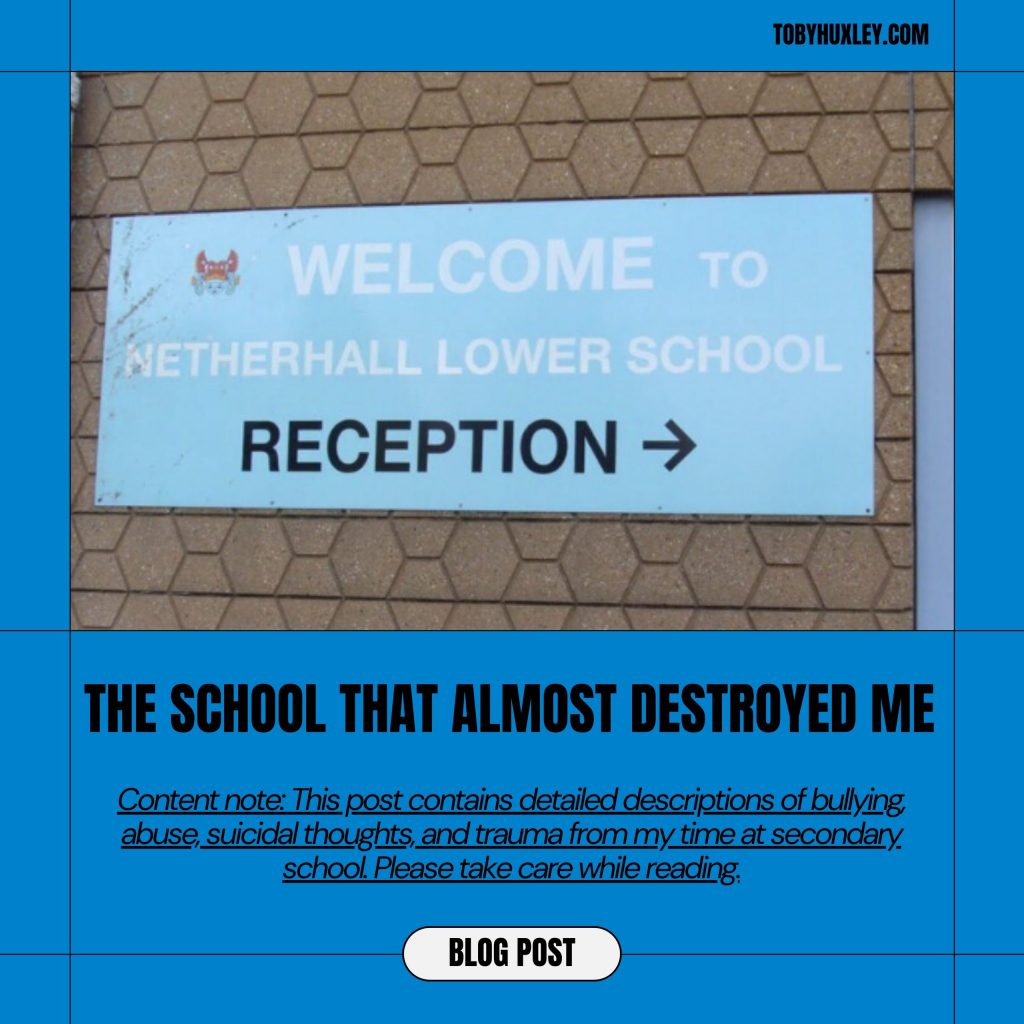
Content warning: This post contains detailed descriptions of bullying, abuse, suicidal thoughts, and trauma from my time at secondary school. Please take care while reading.
If you do take the time to read it, please leave a comment. Thank you.
For five years, school was not a place of learning, safety, or anything remotely resembling care. It was a place where humiliation was daily, violence was routine, and cruelty had an audience. I was lied about so often, and so convincingly, that the truth stopped mattering. Rumours spread, people believed them, and those lies became permission for even more abuse. Lunch breaks were not a break at all, but something to survive, spent hiding in corners, empty spaces, and anywhere I thought I might not be found. Even that never guaranteed safety.
In lessons, I was singled out as the “problem child”, pushed to the front of the class and turned into something between a joke and a target. Elastic bands, spit balls, and whatever else people could get away with were aimed at me while teachers joined in with taunts or stood by and let it happen. Drawing pins were left on my chair so they would go through my skin when I sat down, and even then I learned not to react, because reacting only meant another beating later for daring to make it known. My belongings were never really mine once they were in school. Things were stolen from my bag, broken, thrown into puddles, or set alight with Bunsen burners for somebody else’s amusement.
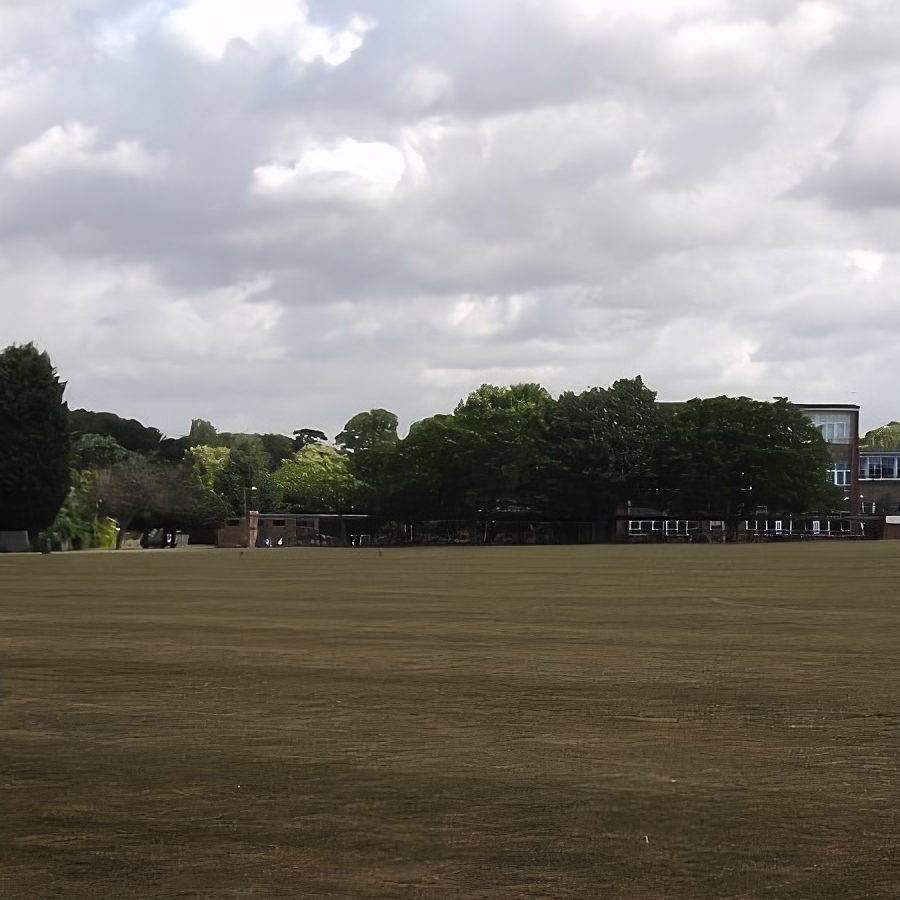
Even the quieter routes, the long ways round, the desperate attempts to avoid people, were not safe. On the school playing fields, after choosing a path I hoped would spare me, someone stubbed a cigarette out on my neck, kicked me to the floor, and rode a bike over me. People saw it. They laughed, or they kept quiet. Again and again, what hurt almost as much as the violence itself was the silence around it, the way other people could watch something awful happen and decide it was easier, safer, or funnier to do nothing.
The lies did not stop at petty rumours. I was even suspended after helping a puppy back into the garden it had escaped from, because a group of bullies thought it would be funny to claim I had kicked it and thrown it like a rugby ball. That was the world I was in: one where doing the right thing could still be twisted into something ugly, and where the people telling the lie were trusted more than the person living through it. Through all of this, the headmistress (Miss Cannie) blamed me. Not the people humiliating me, assaulting me, stealing from me, burning my things, or turning every day into a gauntlet. Me. That was one of the hardest lessons school taught me: not just that people could be vicious, but that the adults meant to protect you could decide you were easier to blame than defend.
And for five years, that was simply my normal.
I started at Netherhall School in 1995 with the kind of hope only a child can carry into something they have not yet learned to fear. I had just left primary school and was genuinely excited about starting what everyone called “Big School”. The day before, my mum had taken me shopping and bought me a new school bag, a new pencil-case, and all the usual bits and pieces you need when you are starting somewhere new. I was proud of those things in that very simple, wholehearted way children are proud of new things. To me, they meant a fresh start. They meant growing up. They meant I was about to step into something bigger, better, and full of possibility. I really thought I was going to love it.
I arrived at the concrete area outside the lower school, where the Year 7 to 9 pupils gathered, and looked around for familiar faces. There were a few people I recognised from primary school, but none of the friends I had actually been close to. They had all gone to St Bede’s. So I stood there with that first-day mixture of nerves and hope, telling myself it would be fine. I would make new friends. That was what secondary school was supposed to be, wasn’t it. A new chapter. A bigger world. A chance to become yourself.
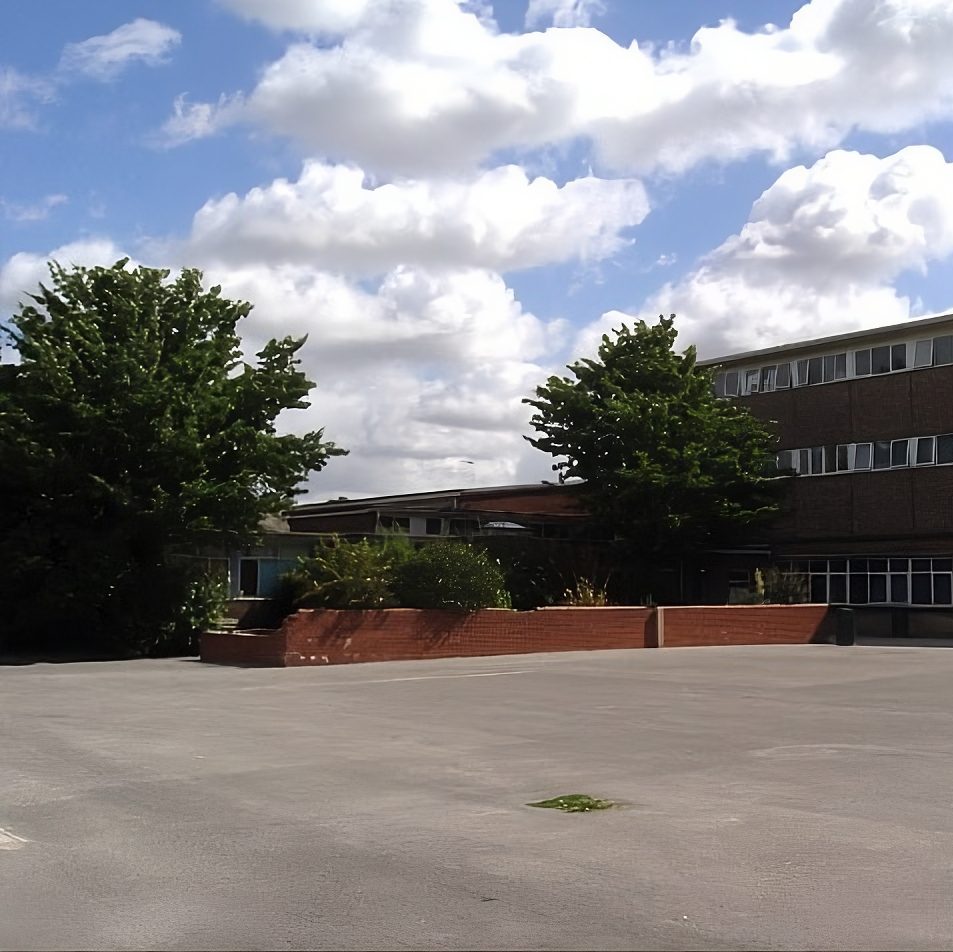
When the form tutors began reading out the names of the forms and the pupils in each one, I misheard my name and followed Form 7Q. For a brief moment, it felt like luck was on my side. The class seemed nice. I even knew one of the boys already because our mothers were best friends. I started settling in almost immediately. I was beginning to relax, beginning to feel that maybe this whole thing was going to be okay after all. Then the door opened, and Miss Powell from 7Y walked in to speak to Mr Munro. I saw them glancing over at me, pointing, and then came the correction. I was in the wrong form. I did not belong there. I had to leave.
It sounds like a small thing now, maybe even trivial to anyone reading it from the outside, but I still remember the feeling of being removed from the one place that had started to feel safe before I had even properly arrived. I had only just begun to find my footing, and already it was gone. Still, I tried to stay optimistic. I told myself 7Y would be fine too. Why wouldn’t it be.
Miss Powell took me from the art rooms where 7Q were based to a maths room on the top floor where 7Y were waiting. It felt like miles. When we arrived, she introduced me, told me where to sit, and then disappeared again, as if I had simply been delivered to the correct shelf and properly filed away. I looked around the room for someone, anyone, who might make it feel less lonely. There were a few boys from my old school, boys I did not know well but knew well enough to say hello to. They blanked me. Completely. I tried speaking to a few of the new people around me. Some glanced at me and then looked away. Some did not answer at all. Even before the real cruelty started, there was that immediate message: you are not wanted here.
So I went quiet. I focused on filling out my planner, copying down my timetable, trying to cling to something normal. I remember looking at those first lessons, Maths and Drama, and trying to feel excited about them. I was still trying, still hoping the day might recover.
Then I realised my pencil-case was missing from my bag. I heard laughter from another table, turned towards it, and felt it slam into my face at full force. In an instant, my face and hands were covered in fountain pen ink. My brand-new pencil-case, the one I had been so proud of less than a day earlier, was ripped and ruined. I looked around but could not tell who had thrown it. I felt the tears rising, hot and humiliating, but I forced them back. Even then, on the first day, something in me already knew crying would only make it worse. So I sat there waiting for the teacher, thinking at least an adult would see what had happened and deal with it.
Instead, when she came back into the room, before I could say a word, she looked at me and bellowed, “You stupid boy, what have you done? Go and wash your face and hands and then you can wash down the table afterwards!”
That was the first day.
Not the first bad day. Not the beginning of things turning sour after a promising start. The first day. Before I had even had the chance to become anyone in that school, I had already been humiliated, targeted, and blamed for what had been done to me. That should have been the warning for everything that followed.
From there, the bullying did not just continue, it established itself. It became the atmosphere I moved through every day. Taunts, shoves into lockers, spit on my blazer, my hair set on fire, constant intimidation, constant testing, constant reminders that I could be touched, mocked, cornered, and degraded whenever anyone felt like it. On the odd occasion there might be a lighter day, but that was all it ever was: lighter, not safe. The cruelty built in size, frequency, and confidence because nobody meaningfully stopped it. It was as if the school had decided, early on, exactly what role I was going to occupy there, and from then on everyone else was allowed to play along.
In Year 9, I fell from the swings at my local park and broke my humerus. There were people from school there when it happened, people who knew exactly who I was, where I lived, and how to find my mum. I was in agony, begging them, pleading with them to go and get her, but they did not help. They stood there pointing, gathering round, and laughing at me while I lay there injured. For forty-five agonising minutes, my pain was entertainment. It did not matter that my arm was broken. It did not matter that I was frightened, desperate, and clearly needed help. What mattered to them was the spectacle of it, the chance to watch me suffer and enjoy it. Eventually, one of them must have found the smallest scrap of conscience and went to fetch my mum, but by then the damage had already been done in more ways than one.
After some time away from school recovering, I went back, and even then there was no pause, no mercy, no sense that what had happened might have bought me even a moment’s peace. The very first thing that happened on my return was that one of the people who had been there that day walked past me and punched me hard in the broken arm. Not by accident. Not messing about. Deliberately. I was convinced for a moment that it had been broken all over again. Thankfully it had not, but the pain lingered for weeks. That was the level of cruelty I had become used to: even visible injury was not a line people would not cross. If anything, it made me more of a target. Weakness, pain, vulnerability, all of it was treated like an invitation.
Later that same year, after yet another episode of bullying during a lesson, something in me finally snapped. There is only so much a person can take before the pressure has to go somewhere, and by then I was already carrying far more than any child should have had to carry alone. I picked up a chair and threw it across the room. Even in that moment, with all that anger and despair surging through me, I knew exactly what I was doing. I was not trying to hit anybody. I threw it at the wall because I needed the noise, the impact, some outward sign of the chaos and pain that had been trapped inside me for so long. I wanted out. Out of the lesson, out of the room, out of the school, out of a place that had become synonymous with fear, humiliation, and harm. I could not cope with it any more.
And of course, in the way these things so often work, my reaction became the problem. Not the relentless bullying that led to it. Not the daily cruelty. Not the years of being pushed, mocked, targeted, and worn down. The breaking point was noticed more than everything that had driven me there. That was part of the sickness of it all: the abuse could continue for as long as it stayed convenient or ignorable, but the moment the damage showed itself, suddenly that was the issue.
Due to my exclusion, I began having out-of-school lessons with a man called Mr Sawyer, a teacher in his sixties who was meant to work with me two days a week. It was nowhere near enough, but it was still education, and at that point I was desperate for any scrap of proper learning I could get. That is the part people often miss. Even after everything school had already done to me, I still wanted to learn. I still cared. I still hoped that if I were given even a half-decent chance, I might be able to build something from the wreckage. On the days I was meant to be taught, Mr Sawyer would pick me up from my house in his car and drive me to a small classroom hut somewhere in the city.
At first, it seemed as though this arrangement might actually help. For a week or two, there was at least the appearance of teaching, some sense that this was a serious attempt to give me back a piece of the education the school had already torn apart. But that did not last. Very quickly, it became clear that my time was not being treated as valuable, and neither was I. Lessons became erratic, half-hearted, and secondary to whatever Mr Sawyer felt like doing. Instead of teaching me, he started using the time to shop for bathroom appliances for his wife, as if the hours meant for my education were his to waste on domestic errands. Even then, I said nothing. I was a very different person then from the man I am now. I had already been taught, over and over again, that my discomfort did not matter, that I was not allowed to object, that I should take what I was given and be grateful for it. So I sat in silence and let it happen, because by that point silence felt like the only role I was ever allowed to play.
And it was not just the waste of time that felt wrong. There was something deeply uncomfortable about the way he behaved around me, something I did not have the language or confidence to properly challenge then, but which I can recognise far more clearly now. He would hold eye contact for far too long, in a way that did not feel normal or safe, a kind of lingering, uneasy stare that made being alone with him feel tense and exposed. In the car, or at the end of what were supposed to be lessons, he would sometimes put his hand on my leg and leave it there for uncomfortable stretches of time. I remember how trapped that made me feel, how I would freeze and wait for it to end, because freezing had already become one of my main survival skills by then. I did not know how to object. I did not feel I had the right. By that stage in my life, so many boundaries had already been crossed by so many people that discomfort had become almost ordinary, something to be endured rather than named. That does not make it any less wrong. If anything, it makes it worse. I was a vulnerable child, already isolated, already damaged by what school had put me through, and even this supposed alternative, this supposed support, came with its own layer of unease and misuse.
After the stop-start teaching, the wasted time, and the general sense that I had once again been handed over to an adult who could do as he pleased with no real accountability, I was eventually invited back to school. Even that return carried its own sting. By the time I came back, everyone else had already chosen their options for Years 10 and 11, the subjects that would shape their GCSE years. I knew what I wanted. I chose Food Technology, Child Development, and Drama, subjects I actually cared about, subjects that felt like they might have given me something to hold onto. Instead, I was promptly told I was doing History, Economics, and German. That was that. No real discussion, no sense that my choices mattered, no acknowledgement that I had already missed out on enough. Once again, decisions were simply made around me and handed down as fact. I was left with the sinking sense that I had been treated as an afterthought, something left until the end, a problem to be placed wherever there was room. A lost cause.
Years 10 and 11 were grim in a quieter, more worn-down way, but no less damaging for that. By then, the bullying was not some shocking new thing. It was the backdrop to everything, the atmosphere I moved through every day. I had somehow managed to gather a few friends around me, which on the surface might sound like things had improved, but even that rarely felt secure. Too many of those friendships were fragile, easily poisoned by lies, gossip, and the constant social manipulation that seemed to follow me everywhere. People would listen to things said about me, believe them, repeat them, or distance themselves just enough to remind me that nothing was ever solid. Not everyone was like that, but enough were that even friendship could feel unstable, conditional, and unsafe. It was hard to relax into closeness when so much of my experience had taught me that people could turn cold, go quiet, or join in at any moment.
Lunch breaks were their own kind of misery. An hour can feel like forever when you are trapped somewhere you do not feel safe. I would spend that time wandering the school grounds aimlessly, trying to look like I had somewhere to be, while really just hoping not to catch anyone’s eye. The whole thing became a kind of low-level survival exercise: keep moving, stay alert, avoid groups, avoid corners where someone could trap you, avoid open places where you could become a spectacle. And when it all felt too exposed, I would hide in the library, tucked away in a corner as far from the windows and doors as I could get, trying to make myself small, quiet, and forgettable. That was what lunch had become for me, not rest or friendship or any kind of ordinary break in the day, but a daily exercise in minimising myself so I might get through it unscathed.
By then, all of it was taking its toll on me in ways that were visible as well as invisible. The bullying fed directly into comfort eating, and I comfort ate a lot. Food became one of the few things that could offer any kind of temporary relief, any brief sense of softness or escape from the constant stress, fear, and humiliation. Of course, that did not solve anything. It just gave the pain somewhere else to go. I became very overweight, and with that came another layer of misery: more shame, more self-consciousness, more reasons for people to stare, comment, or treat my body as something public and laughable. I was deeply unhappy, carrying far more than anyone around me seemed willing to see. By that point I was not really living as a teenager should have been living. I was enduring, hiding, and trying to make it from one day to the next in a place that seemed determined to crush whatever confidence or ease I had left.
The darkest period of my school years came in Year 10, when everything had finally worn me down to the point where I could not see beyond the pain of it. By then, school was not something I simply disliked or dreaded, it was something that had got inside me. It had hollowed me out. The bullying, the humiliation, the isolation, the constant fear, the feeling of being hated, blamed, laughed at, and left completely unprotected had built up for so long that I stopped being able to imagine a future beyond it. I was exhausted in a way no child should ever be exhausted. Not just tired, but emptied. Spiritually, emotionally, mentally emptied. I did not want attention. I did not want to make a point. I wanted it to stop.
I lived next to a train track, and in my head that became the answer. Not because I was dramatic, or reckless, or trying to scare anyone, but because I had reached a place where death felt easier to imagine than another day of being me in that life. That is a devastating thing to admit, even now. But it is the truth. In my heart and in my mind, I genuinely believed there was no way out. No rescue was coming. No adult was going to step in and change things. No sudden kindness was waiting round the corner to undo what had already been done to me. I felt crushed under the sheer weight of it all, and I wanted the pain, the fear, the dread of waking up and having to keep going, to end.
So I walked to a nearby park, because I knew the wire fence by the tracks was easy to get through. I remember the horrible clarity of it, the numbness of having made a decision that should never have felt possible, let alone calm. I stepped through the fence and made my way down the slope towards the tracks. I could hear the train getting closer. And in that moment, standing there with all that noise and force coming towards me, I truly believed that was it. That was how my life was going to end. Not with help. Not with anyone finally understanding what had been happening to me. Just with impact. With disappearance. With an end.
And then, in the space of a second, everything changed. A random passer-by saw what was happening, acted without hesitation, and rugby tackled me across to the other side of the tracks. The train was seconds away. Seconds. He saved my life with no warning, no discussion, no time to think, just instinct and speed and humanity. He reached for me at the exact moment I had stopped believing anybody would.
And even then, I was so overwhelmed, so angry, so trapped inside everything I had been carrying, that I ran from him. I never got his name. I never thanked him properly. I never gave him the chance to know that what he did mattered more than I can ever put into words. He interrupted the worst moment of my life and, without knowing me at all, gave me back every year I have lived since.
I do not know who he was. I only know that I am still here because of him.
Thank you for saving my life.
Year 11 was the year I found a way to escape school without anyone immediately realising. If I did not have an exam, I would stay on the bus instead of getting off at school, ride it through to the city centre, and disappear into the library for the day. That was what it had come to. I was no longer trying to survive school from within it, I was trying to survive by avoiding it altogether. The thought of walking through those gates, of putting myself back into that building and that atmosphere and that constant state of dread, had become unbearable. I could not keep forcing myself into a place that had already taken so much out of me.
The library became my refuge, my hiding place, my substitute for all the safety and calm school had never offered. There was a computer area with free internet, and I would spend hours there reading about body language, trying to understand people better, trying to decode the kind of world that had so often felt hostile, unpredictable, and cruel. Looking back, there is something heartbreaking to me about that. While other teenagers were simply going to school and getting on with their lives, I was sitting in a library trying to study human behaviour like it might somehow explain why people had treated me the way they had, or help me protect myself from it in future. It was an escape, but it was also a kind of quiet desperation, trying to make sense of a world that had never made sense to me.
I would stay there until it was nearly time for school to finish, then make sure I caught the bus that linked back up with the school route home, so that from the outside everything still looked normal. I had worked out a system. A way of vanishing while still appearing to have been where I was supposed to be. And for a while, it worked. But of course it could not last forever. Eventually the school realised I was not coming in. And by then, the truth was simple: I refused to go back. I could not bring myself to do it. The fear, the dread, the exhaustion, the damage of everything that had happened there had finally overwhelmed whatever ability I had left to keep pretending I could cope.
After a great deal of aggravation, pressure, and being dragged back towards the place I had been trying so hard to escape, I returned on the second-to-last day of school. Even that feels grimly absurd to me now. After everything, after years of misery, fear, humiliation, and harm, I was pulled back in right at the end, only to be told by the headmaster that I was not to come in the following day, the final day of term. And so that day, almost by accident, became the day I was finally released from a place that had very nearly destroyed me. There was no grand recognition of what had happened to me there, no apology, no justice, no sense that anyone understood the extent of the damage. Just an ending. A door shutting behind me. Freedom, but only after years of being broken down inside its walls.
After school, I got my GCSE results and planned to go on to college. Despite everything, despite how badly education had failed me, some part of me still wanted more for myself. I still wanted to learn, still wanted a future that looked like something other than survival. But even then, there was another let-down waiting. The college somehow messed up my application, and I was told I would have to wait until the following year to apply. It felt like one more door closing in my face at the exact moment I most needed life to open up.
By that point, I was burnt out in every sense of the word. Worn down by years of hostile classrooms, failed support, missed chances, and the sheer emotional labour of trying to exist in environments that had never felt safe. I could not face putting myself back into another educational setting only to be let down again. So I did not reapply. I gave up on that path and decided to get a job instead. But the damage did not stop just because school had ended. It followed me out. In the aftermath came a fixation on weight loss and an eating disorder, another way that pain found somewhere to live in my body. School did not end neatly for me when I left it. It carried on in what it had done to my mind, my self-worth, and the way I learned to cope.
Throughout those school years, I kept diaries, something I had done since I was about eight, and they became the only place where any of it was allowed to exist honestly. Page after page, I poured everything into them: the fear, the shame, the anger, the confusion, the humiliation, the things done to me and the things said about me, all the pain I could not safely speak out loud. Those diaries held the version of me nobody saw, or perhaps the version nobody wanted to see. At school, I learned very quickly that telling people did not make me safer, it just made me more exposed. So I stopped telling people. I kept it all on paper instead.
Somewhere along the way, that kind of treatment starts to get inside you. It stops feeling like something being done to you and starts feeling like something about you. You stop thinking, this is wrong, and start wondering whether maybe you really are the problem after all. I think part of me began to believe I deserved it, or at least that there was no point asking for help because help was never really coming. What could anyone do, when the cruelty was constant and the adults who should have intervened either ignored it, joined in, or blamed me for it? That is one of the most damaging things bullying does. It does not just hurt you in the moment. It changes the way you understand yourself. It teaches you that your pain is ignorable, that your voice changes nothing, and that survival depends on swallowing what is happening and carrying it alone.
I still cannot bring myself to read those diaries now. I am vastly stronger than I was then, but I know exactly what would happen if I opened them. It would not just upset me, it would drag me straight back into the rawness of it, into the full, unsoftened truth of what those years were. Not memory blurred by time, not a version polished into something more palatable, but the real thing. The day-by-day reality of being frightened, isolated, humiliated, blamed, and worn down in a place I was supposed to be safe. A place that was meant to educate me instead taught me fear. A place that was meant to protect me taught me that adults could watch suffering and still choose convenience, silence, or blame.
And more than sadness, I think what I would feel is rage. Real rage. Rage at how relentless it was, how normalised it became, how many people watched it happen and did nothing, and how completely they got away with it. Because they did get away with it. They carried on with their lives while I carried what they did for years afterwards. They got to leave those corridors and classrooms behind, while I left with the damage stitched into me. I know who they are. I know what they did. Time has not made it smaller, kinder, or more forgivable. It has only made it clearer. And there are some things a person should never have to forgive.
I am writing this not because I enjoy reopening any of it, and not because I want pity, but because silence protects the wrong people. For too long, what happened in schools like mine has been minimised with softer language and smaller words. Teasing. Bullying. Rough behaviour. Kids being kids. As though that makes it harmless. As though fear becomes less real if you give it a tidier name. But there was nothing small about living like that. Nothing ordinary about dreading each day before it even began. Nothing harmless about being taught, over and over again, that your pain did not matter, that your truth would not be believed, and that the people meant to protect you might instead stand back and let it happen.
What happened to me did not stay in school. It followed me out through those gates and stayed with me long after the uniform, the classrooms, and the timetables were gone. It lodged itself in my mental health, my body, my confidence, my self-worth, and my sense of safety. It stayed in the way I saw myself, in the way I coped, in the way I went quiet, in the way I learned to expect harm and brace for it. Some people left school with memories. I left with survival strategies. Some people look back and remember lessons, friendships, and ordinary teenage things. I remember fear, humiliation, silence, and the slow erosion of a child who should have been protected.
So this is not just a story about school. It is a story about what prolonged cruelty does to a child, and what it costs to grow up believing you are on your own. It is about what happens when suffering is normalised, when help does not come, and when the people with the power to stop it choose not to. I survived it, but survival is not the same thing as being untouched by it. I am still here, and I am stronger than the person who lived through those years, but that does not mean those years did not matter. They did. They shaped me. They wounded me. They followed me. And they deserve to be named plainly, without softening, for what they were.

I wish I’d known the depth of what you were suffering then. I feel so sad for what you went through. I would have done what I could xxx